Microwave Filter Selection
Filters define what a system is allowed to hear and what it is allowed to transmit. In crowded spectral environments — and in space and defense systems in particular — filter performance often determines whether a receiver can operate at all near a high-power transmitter.
Filter Types
- Lowpass — passes everything below a cutoff frequency; commonly used for harmonic suppression after an amplifier or multiplier
- Highpass — passes everything above a cutoff; used to reject low-frequency interference and DC offsets
- Bandpass — passes a defined band and rejects everything else; the workhorse of receiver front ends and LO chains
- Bandstop (notch) — rejects a narrow band while passing the rest; used to null a specific known interferer
What Drives the Design
Every filter is a negotiation between four competing goals: passband insertion loss, stopband rejection, selectivity (how sharply the response transitions), and size. Improving any one of them generally costs something in the others. A sharper skirt means more resonator sections, which means more insertion loss and a larger package. Getting that balance right for a specific system is the design work.
Group delay flatness matters as well in wideband digital and radar systems, where phase distortion across the passband degrades pulse fidelity and modulation accuracy. In space and airborne applications, thermal stability and mechanical robustness carry equal weight with electrical performance.
Applications
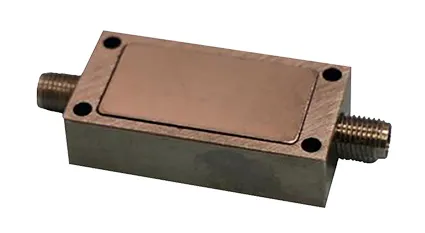
Princeton Microwave filters are used in satellite payloads and ground terminals, radar transmit and receive chains, electronic warfare systems, and test instrumentation. Custom frequency plans, connector configurations, packaging, and environmental screening are available.
Related products: Oscillators | Couplers | DC Blocks | Bias Tees | Satellite Components
Technical reading: High Performance Microwave Filters in Space Applications | Design & Manufacturing Capabilities