Choosing the Right Microwave Oscillator
Every RF and microwave system is built on a frequency reference, and the source you choose sets a ceiling on what the rest of the system can achieve. No amount of downstream signal processing recovers performance lost to a noisy oscillator. Princeton Microwave builds three families of sources, each suited to a different balance of phase noise, frequency agility, and stability.
Dielectric Resonator Oscillators (DRO)
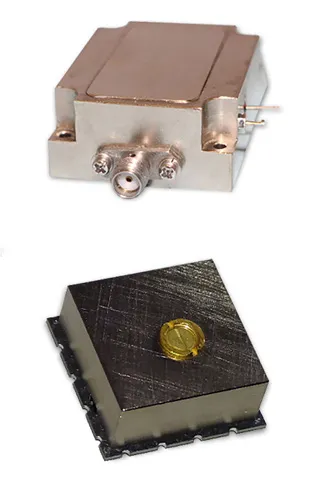
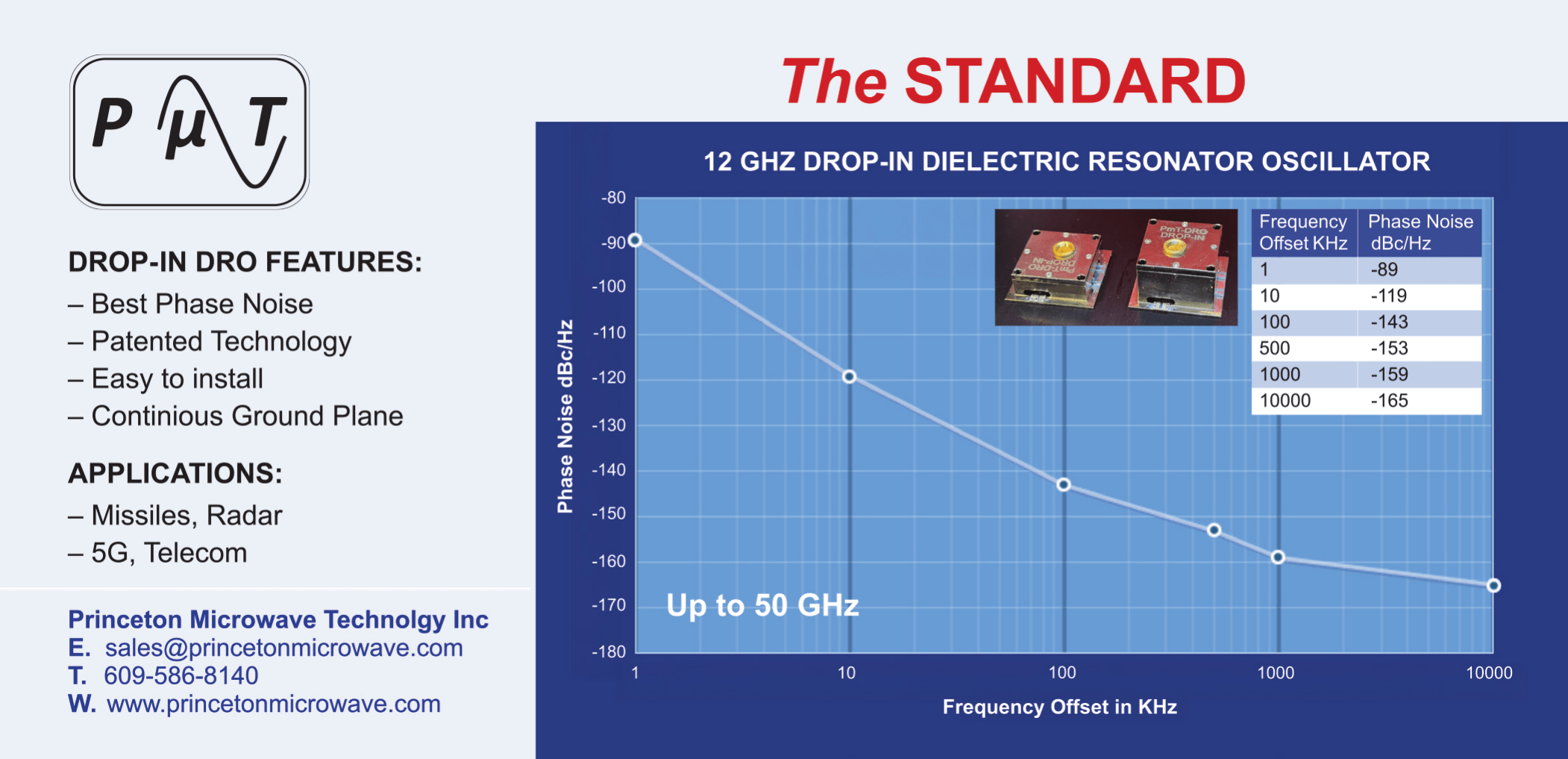
A DRO uses a high-Q ceramic resonator as the frequency-determining element. That high resonator Q is what delivers excellent close-in phase noise at a fixed frequency, with no phase-locked loop in the signal path to add noise of its own. DROs are the usual choice for fixed local oscillators in radar receivers, satellite up- and down-converters, and point-to-point radio links where the operating frequency never needs to change.
Phase Locked Oscillators (PLO and PLDRO)
A phase locked oscillator locks a DRO or VCO to a crystal reference, combining the DRO’s low close-in noise with the absolute frequency accuracy and long-term stability of quartz. This is the right choice when a system has to hold frequency precisely over temperature and time, or when several units must remain coherent against a shared reference. PmT phase locked oscillators use sampling phase detector technology, which avoids the noise multiplication penalty that conventional divider-based loops introduce inside the loop bandwidth.
Synthesizers
Where the application calls for tuning across a band — frequency-agile radar, electronic warfare receivers, automated test equipment — a synthesizer provides programmable output frequency. The tradeoff is phase noise: the dividers and loop circuitry required for tunability place synthesizer noise above that of a comparable fixed-frequency source.
Typical Applications
- Pulsed Doppler and synthetic aperture radar reference and local oscillators
- Satellite communications up- and down-converters
- Electronic warfare and signals intelligence receivers
- Missile seekers and guidance electronics
- Test and measurement reference sources
Every Princeton Microwave source is characterized with a phase noise mask across multiple offset frequencies, so the data drops directly into a system link budget rather than leaving you to interpolate from a single headline number. Custom frequencies, packaging, and screening are available for military and space programs.
Explore our oscillator families: Dielectric Resonator Oscillators | Phase Locked Oscillators | Synthesizers
Technical reading: Understanding Low Phase Noise | Sources of Phase Noise | PLO Fundamentals | How Low Noise Oscillators Improve Radar Systems